BESS Civils: Battery Energy Storage Foundations and Site Works
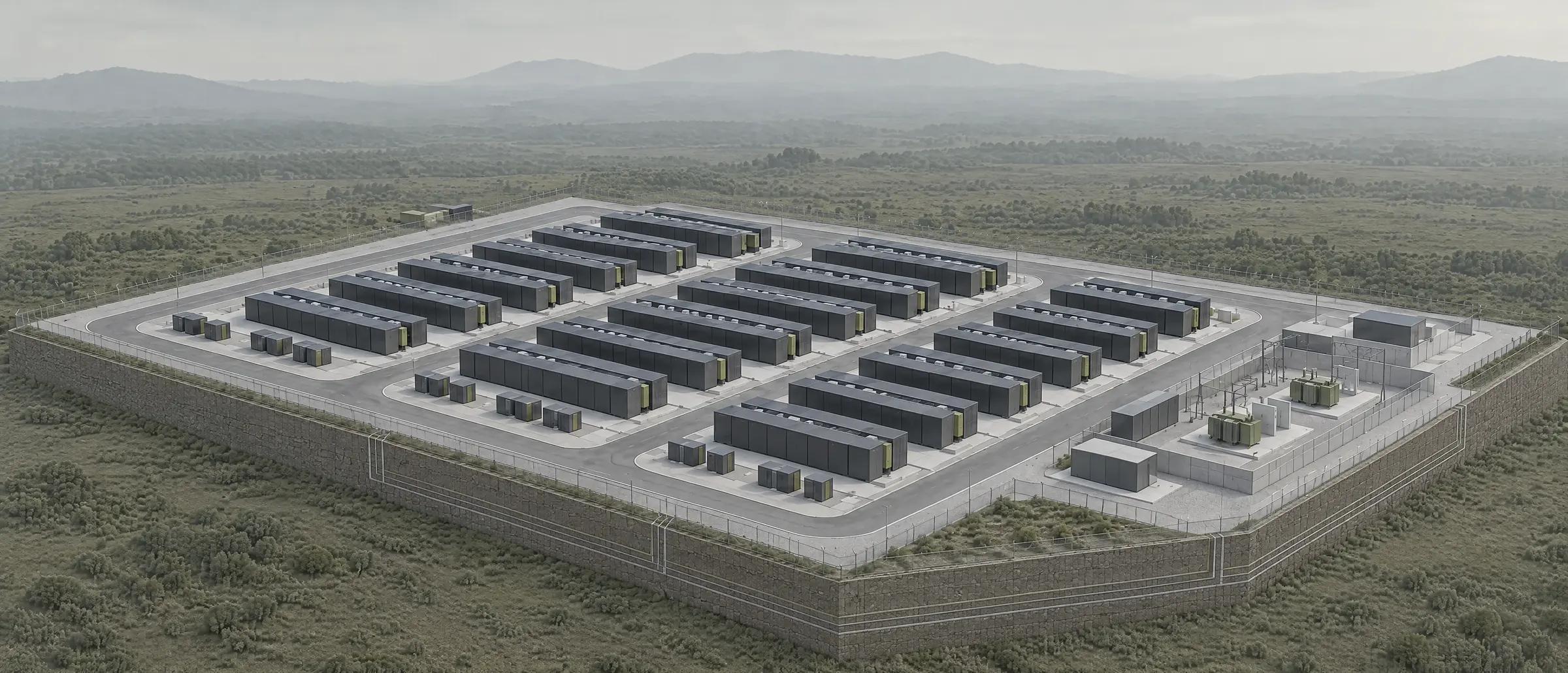
Battery energy storage is moving from a niche to a backbone of the European grid, and the civils underneath it are now a discipline in their own right. A BESS site is, before anything else, a ground and concrete problem: a level, stable platform that carries heavy battery and inverter units for twenty years or more, drained and ducted for equipment that has not yet arrived, and tied into the grid through an electrical compound built to high-voltage tolerances.
Maveric self-delivers the full civil scope for utility-scale BESS — its own crews and its own plant, from a cleared site through to a handover-ready compound with a complete digital record. Founded in Galway in 2004 and operating across Ireland, Germany and Norway, we treat battery storage construction as the engineered, accountable groundworks programme it is, not a slab poured at the end of someone else's package.
What BESS civils actually cover
A battery energy storage scheme depends on a sequence of civil works that has to be right before a single container lands. The platform sets the level and the long-term stability; the drainage and ducting are buried to capacity before the slabs close them off; the electrical compound civils are coordinated around plant that arrives heavy and tightly toleranced. The BESS foundations and slab are the visible part, but they sit on a much broader scope.
We self-deliver that scope as one continuous programme rather than a series of separate appointments, so the platform, the services beneath it and the foundations on top of it stay under one set of hands and one quality record.
- Full site establishment and civil delivery for BESS and AIS electrical compounds
- Bulk earthworks and engineered platforms with geogrid reinforcement and structural fill
- Container pad slabs and reinforced concrete foundations for battery, inverter and transformer skids
- Internal road networks, perimeter security civils and access controls
- Stormwater drainage with large-diameter pipelines and hydro-brake manholes
- Firewater supply infrastructure with PE mains and a hydrant network
- Multi-way HV/MV/LV duct banks, reinforced cable pits and underground utility chambers
- Groundwater control and environmental protection through construction
- Supply and fitting of precast concrete
Engineered platforms built for the load and the lifespan
Battery containers, inverter skids and transformers are heavy, concentrated and unforgiving of differential settlement. The platform they sit on has to be built to long-term ground-stability tolerances, not approximate ones, because a soft or uneven base shows up years later as cracked slabs and misaligned plant.
Maveric builds these platforms with geogrid reinforcement and structural fill over stabilised sub-bases, with compaction control and rigorous QA records throughout. Bulk earthworks bring the site to formation in clay, gravel and soft rock; cut-to-fill is balanced on site where ground conditions allow; and material testing is logged and tracked digitally, package by package, so the platform is verified rather than assumed before any foundation goes down.
Container pad slabs and RC foundations
The structural concrete on a BESS site carries the equipment that earns the asset its revenue. Container pad slabs take the battery enclosures; reinforced concrete foundations and plinths carry inverter, transformer and switchgear skids; and the slab and structure for any substation or control buildings sit within the same package.
All of it is formed, reinforced and placed by Maveric crews using Maveric plant. Reinforcing-steel fabrication and fitting, formwork, blinding and placing are in-house capability, which keeps the foundations, the deep services around them and the platform under them governed by one programme and one source of truth — not stitched together across subcontract interfaces where accountability blurs.
Buried services: drainage, firewater and the duct network
Most of a BESS programme's risk is buried. Stormwater drainage has to be sized for the runoff of a large hardstanding compound, with hydro-brake manholes and attenuation managing discharge. Firewater is built to project, insurer and authority requirements — PE mains, a ring or hydrant network and isolation valves. And the electrical and telecoms ducting is the spine that connects the batteries to the grid.
These services are laid early, to capacity, for equipment that has yet to arrive, because none of it is easy to revisit once the slabs are down. Maveric finds and exposes any existing buried services without strikes using ground-penetrating radar and vacuum excavation, then records every service identified in its in-house digital backbone so the as-built record is complete and defensible at handover.
- Stormwater drainage with large-diameter pipelines, hydro-brake manholes and attenuation
- PE firewater mains, ring networks, hydrants and isolation valves
- Multi-way HV/MV/LV duct banks and high-capacity telecoms service corridors
- Reinforced cable pits and underground utility chambers
- Temporary and permanent groundwater control across the lifecycle
BESS and substation civils, delivered together
Battery storage rarely arrives alone. It frequently co-locates with substation and grid scope — an AIS electrical compound, transformer plinths and bases, blast walls, earthing grids in copper tape and rods, and the grid-route civils that carry the connection from the compound boundary to the network point.
Because Maveric self-delivers substation and high-voltage civils up to 400 kV in the same way it delivers the BESS scope, a co-located scheme can be carried by one contractor rather than re-procured at the fence line between the battery compound and the electrical yard. The heavy lifts of transformers and control kiosks, the cable trenches and the duct banks at 110, 220 and 400 kV all sit within the same self-delivered programme, sequenced around energised plant.
Self-delivery and a complete digital record
Engaging a contractor on a grid-scale battery project is a decision about control before price. Maveric self-delivers — the crews on site and the plant they run are ours, not subcontracted — so the organisation that prices the works is the one that builds them and stands behind them on safety, quality, programme and cost.
Setting-out and earthworks are controlled by GPS machine control to fine tolerances; material testing, inspections and as-built records are captured digitally, package by package; and the compound is turned over with a complete record of what is in the ground. All of it runs under management systems aligned to ISO 45001 for safety, ISO 14001 for environment and ISO 9001 for quality, under one commitment — Home Safe. Every Shift. Every Day.
Information for pricing a BESS civil package
Maveric self-delivers the civil scope described on this page with our own crews and plant. Defining that package requires more than a battery capacity and a site location. The ground conditions, equipment layout and buried-service interfaces all affect what has to be built.
The following information helps a project team define the package for pricing. Share the available documents at enquiry stage and identify anything still under development.
- Site boundary, planning reference and compound layout drawing
- Ground investigation reports, or confirmation that none exists yet
- Battery, inverter and transformer details, including base loads, footprints and fixing requirements for each unit
- Drainage outfall, firewater requirement, and any authority or insurer conditions
- Electrical or civil interface drawings showing duct routes, cable entry points and the grid connection point
- The programme, including the planned date for the first equipment delivery
- Existing buried services, with survey records where available
Responsibilities to agree for each contract
Record the agreed scope boundaries in the tender and contract documents. A list of civil works should not be read as an allocation of electrical design, equipment supply or commissioning responsibility.
Civil, electrical and equipment work can be split between several parties. Agree the following responsibilities in the project scope rather than assume they sit with the same contractor:
- Who designs the platform, slabs, drainage, firewater and duct banks, and to which loads and drawings
- Who designs, supplies and installs the electrical equipment, and who holds system-level safety responsibility
- Who supplies, installs and commissions the battery and power conversion units
- Who provides temporary works, site access and equipment storage
- Who keeps the as-built record for each underground service
Equipment interfaces
Equipment selection affects the foundation layout, fixing details, cable entries and delivery arrangements. Coordinate the supplier's issued information with the civil drawings before the affected foundations and buried routes are constructed. Manufacturer requirements are specific to the equipment selected; one product's foundation or installation details are not a standard for every BESS project.
Resolve the delivery route, lifting access and any temporary storage with the parties responsible for equipment delivery and installation. If units are expected before the civil works are complete, agree who provides suitable access, storage and protection, and how that changes the works sequence. Keep those interfaces visible in the programme rather than treating the first equipment delivery as a date independent of the civil package.
Frequently asked questions
What are BESS civils?
BESS civils are the civil engineering and groundworks that a battery energy storage site is built on — site establishment, bulk earthworks, engineered platforms, container pad slabs, reinforced concrete foundations, drainage, firewater and the underground duct network that connects the batteries to the grid. They are the structural and buried scope beneath the battery, inverter and transformer equipment, delivered before and around the electrical installation.
What foundations does a battery energy storage site need?
A BESS site typically needs an engineered platform built to long-term stability tolerances, container pad slabs for the battery enclosures, and reinforced concrete foundations or plinths for inverter, transformer and switchgear skids. The platform usually combines geogrid reinforcement and structural fill over a stabilised sub-base, with compaction and material testing recorded so the ground is verified before any concrete is placed.
Does Maveric deliver BESS civils in Ireland?
Yes. Maveric is an independent European civil engineering contractor founded in Galway in 2004, and it self-delivers BESS civils across Ireland, Germany and Norway. The crews and plant are Maveric's own rather than subcontracted, covering the full scope from site establishment and earthworks through to slabs, drainage, ducting and handover.
Why does battery storage often need substation and grid civils too?
A battery storage scheme has to connect to the grid, so it frequently co-locates with an AIS electrical compound, transformer plinths, earthing and the grid-route civils to the network connection point. Because Maveric self-delivers high-voltage substation civils up to 400 kV alongside the BESS scope, a co-located project can be carried by one contractor instead of being re-procured at the boundary between the battery compound and the electrical yard.
How are buried services protected during BESS construction?
Existing buried services are located and exposed without strikes by combining ground-penetrating radar to detect them with vacuum excavation to dig around them without contact. Every service identified, along with the new drainage, firewater and duct network laid for the site, is recorded in Maveric's in-house digital backbone, so the operator receives a complete and defensible as-built record at handover.
What standards does Maveric work to on a BESS project?
Maveric runs one integrated management system with safety, environment and quality aligned to ISO 45001, ISO 14001 and ISO 9001. Method statements and risk assessments are signed off before work starts, inspection and test plans and material testing run package by package, and the civil scope is handed over with a complete digital record. Maveric's management systems are aligned to these standards rather than certified to them.
Self-delivered civil, structural and enabling works across Europe.
Discuss your BESS projectHome Safe. Every Shift. Every Day.
Contact us